
Introduction
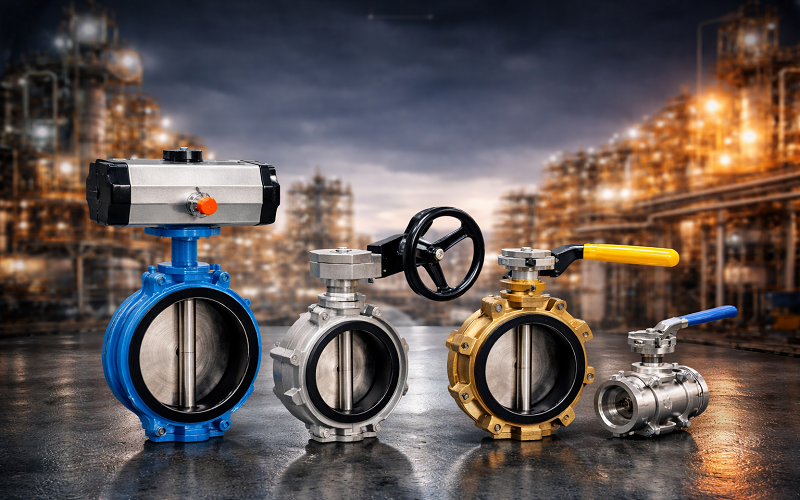
Walk through any fabrication yard or utility plant and you will see them everywhere sandwiched between flanges, painted blue or grey, sometimes bare metal, sometimes epoxy coated. A quarter turn and the line opens. Another quarter turn and it shuts.
A butterfly valve looks uncomplicated. A round disc on a shaft. A resilient seat. A body drilled to match pipe standards. That simplicity is the reason people underestimate how much can go wrong if the manufacturing discipline behind it is weak.
This is not about brochure claims. It is about what actually happens inside factories and how to judge butterfly valve manufacturers based on process control, not catalog language.
Where It Really Begins: Metal Quality
The valve’s life starts long before machining. It begins in the furnace.
For ductile iron bodies and discs, raw scrap composition matters. Excess sulfur, poor nodularity control, or improper magnesium treatment changes mechanical behavior. If the graphite structure is wrong, strength and elongation drop. The disc may crack under pressure spikes years later.
Aluminum bronze is different. Copper-based alloys demand tighter chemistry control. Even slight variations in aluminum or nickel content alter corrosion resistance. In marine conditions, that difference shows up quickly.
Serious factories test melt samples before pouring. Spectrometers are used. Records are kept. If chemistry drifts, batches are rejected. That discipline is invisible in the finished valve, but it defines durability.
Casting Isn’t Just Pouring
People assume casting is crude. It isn’t not when done properly.
Mold compaction, sand moisture content, gating design, and cooling rate all influence porosity. Shrinkage cavities inside a disc are silent threats. They won’t show during low-pressure testing. They may reveal themselves under higher differential loads.
Better plants use controlled mold design and post-casting inspection. Critical surfaces are examined. Some perform non-destructive testing on larger diameters.
A clean casting reduces machining correction later. Less correction means better concentricity. Better concentricity means stable torque.
Machining: Alignment Is Everything
Once the casting is cleaned, machining determines functional accuracy.
The shaft bore must align precisely with the body centerline. If it is slightly off, the disc will not compress the seat evenly. One side seals harder. The other leaks earlier.
Flange faces must be parallel. Otherwise, installation stress transfers to the valve body.
The disc edge finish also matters. A rough seating surface increases friction and operating torque. It also accelerates seat wear.
Factories that invest in CNC machining and proper fixtures maintain repeatability. Manual correction might work for small batches. It does not work at scale.
When evaluating butterfly valve manufacturers, ask how shaft alignment is verified. If the answer is vague, that is a signal.
Disc Material Choice: Not a Cosmetic Decision
Ductile iron discs are common in water systems. They are economical, strong, and work well when coated properly. In municipal lines and fire systems, they perform reliably.
But iron exposed to aggressive media deteriorates. Coating damage, cavitation, or chemical presence shortens life.
Aluminum bronze discs cost more. They resist seawater corrosion, brackish environments, and certain chemicals far better than coated iron. In marine service, the difference is obvious after a few years.
Material selection is not about price alone. It is about fluid compatibility, velocity, and expected service life.
A supplier who pushes one material for all applications is simplifying the conversation too much.
Seat Bonding: The Overlooked Variable
Resilient seated butterfly valves rely on elastomer seats. EPDM for water. NBR for oil. PTFE for chemicals. Viton for higher temperatures.
The bonding process must ensure uniform compression when the disc closes.
If the seat is poorly bonded or dimensionally inconsistent, torque spikes appear. Operators feel resistance. Actuators strain. Leakage increases gradually.
Good manufacturing includes seat dimensional inspection and controlled curing cycles. Temperature and time matter.
You won’t see that on a data sheet. But you will feel it during operation.
Torque Is Not a Guess
Torque numbers in catalogs sometimes represent ideal laboratory conditions. Real-world torque includes friction, pressure load, and seat deformation.
There are three practical torque phases:
• Breakaway torque — initial movement from closed position
• Running torque — steady rotation
• Seating torque — final compression against seat
Under higher differential pressure, torque increases significantly. If actuator sizing is based only on nominal values, failures follow.
Actuator motors overheat. Pneumatic units stall. Gearboxes wear faster.
Reliable manufacturers test valves under pressure to generate torque curves. They document worst-case conditions. That information protects automation systems.
If torque data looks generic, question it.
Actuator Compatibility: Mechanical and Logical Integration
Manual lever valves are straightforward. Once diameters increase, gear operators become necessary.
Automation changes everything.
ISO mounting pads must align precisely. Shaft dimensions must match actuator couplings. Any misalignment causes eccentric loading.
Pneumatic actuators need sufficient air pressure and correct spring return configuration. Electric actuators need torque margin and limit switch calibration.
Beyond mechanical fit, logical integration matters. Position feedback, limit switches, and control wiring must match plant systems.
Inconsistent machining tolerances complicate actuator installation. Field modification increases cost and delays.
Experienced butterfly valve manufacturers design for automation compatibility from the beginning, not as an afterthought.
Pressure Testing: The Minimum Standard
Every valve should undergo hydrostatic shell testing. That verifies structural integrity.
Seat leakage testing confirms shut-off performance. Air testing may also be conducted for sensitive services.
But testing is meaningful only when properly recorded. Traceability numbers, batch codes, and inspection stamps create accountability.
If documentation cannot be produced when requested, reliability claims are weak.
Coating and Surface Protection
In water distribution systems, epoxy coating protects iron surfaces from corrosion. Surface preparation before coating is critical.
Sandblasting removes scale. Surface roughness must fall within a controlled range. Curing must be uniform.
Thin spots in coating expose base metal. Over time, corrosion begins beneath the surface.
Coating inspection tools measure thickness. Serious factories check this routinely.
Maintenance Considerations
Butterfly valves are often expected to operate for years without attention. Eventually, seats wear. Shafts require inspection.
A well-designed valve allows seat replacement without destroying the body.
Spare availability is part of supply chain reliability. A valve that cannot be serviced becomes scrap prematurely.
Before choosing a supplier, check long-term part availability.
Evaluating the Manufacturer beyond the Brochure
A polished website is easy to create. Production discipline is harder.
Look for:
• In-house casting or controlled sourcing
• Machining capability details
• Documented torque testing
• Clear material certification
• Transparent pressure class ratings
• Real inspection records
Visit facilities if possible. Observe workflow. Order a sample. Check dimensions yourself.
Quality shows up in small tolerances and consistent data not in marketing language.
Practical Closing Thought
A butterfly valve rotates only 90 degrees. That movement looks simple. But the reliability of that quarter turn depends on metallurgy, machining accuracy, seat bonding precision, and correct torque calculation.
When selecting among butterfly valve manufacturers, focus on production rigor and verification, not just cost.
Because in piping systems, failure rarely announces itself dramatically. It begins quietly as leakage, rising torque, actuator strain, or corrosion beneath a coating.
Good manufacturing prevents those issues long before the valve reaches the site.
And that prevention is where real value lies.