
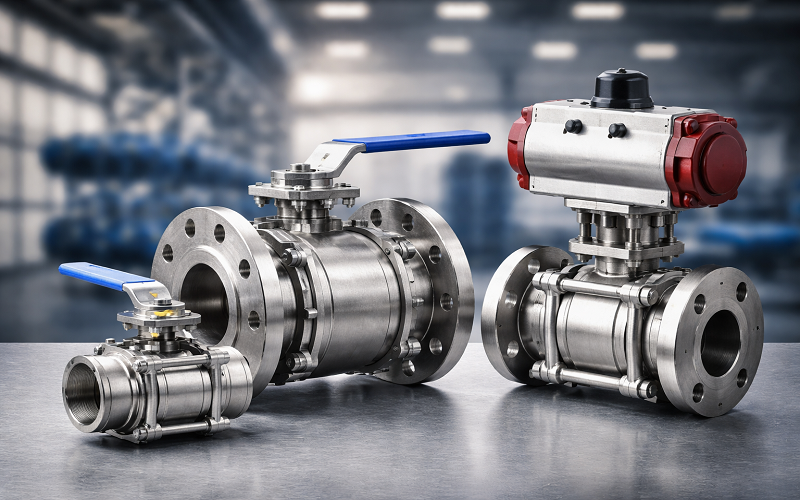
Introduction
The expectation from ball valve suppliers is usually simple on paper the valve should close and not leak. That’s it. No one asks for anything complicated at the time of ordering. Size, rating, end connection, material. Order placed.
But once the valve goes into a running line, things change.
Pressure comes in. Sometimes steady, sometimes not. Temperature shifts. Fluid carries fine particles, sometimes corrosive, sometimes clean. And then the real question shows up does the valve actually shut tight, or does it start passing?
Leakage, in most cases, does not start as a failure. It begins small. Almost unnoticeable. Then it grows.
What separates different ball valve suppliers is how much of that risk is reduced before the valve even leaves the shop.
The Sealing Line inside the Valve
Inside a ball valve, sealing is not spread over a large area. It happens along a narrow circular contact line where the ball meets the seat.
That line has to be clean. Continuous. No breaks.
If there is even a slight mismatch, pressure finds that path.
This is why the ball is not left as machined. It is polished. In many cases, surface roughness is brought down below 0.4 µm Ra for better sealing. The seat surface is also finished to match.
Not doing this properly is one of the most common reasons for early leakage.
A careful approach from ball valve suppliers usually shows up here in how much time is spent finishing parts that are not visible from outside.
Seat Material Is Not One Fit
Seats decide how the valve seals.
PTFE is widely used. It works well because it is soft enough to deform slightly and fill small gaps. It handles moderate temperature, roughly up to 200°C in many cases.
But not all lines are moderate.
If pressure increases or if the fluid carries particles, standard PTFE may wear faster. That is where filled PTFE (glass-filled, carbon-filled) comes in. It improves wear resistance.
At even higher temperature or abrasive conditions, metal seats are used.
Metal seats do not give perfect “soft” sealing, but they survive conditions where soft seats fail.
So the choice is not about what is common. It is about what matches the line.
That decision is usually taken early by ball valve suppliers who understand the application.
Ball Surface Small Damage, Big Effect
The ball looks like a simple sphere. But in operation, it takes direct contact pressure from the seat.
If the surface gets scratched, even slightly, sealing is affected.
This is why many balls are hardened or coated.
Hard chrome plating is common. In more demanding cases, tungsten carbide coating is used because of higher hardness.
These coatings reduce wear and protect the surface from damage.
Without that, the valve may pass testing but lose sealing after some cycles.
Pressure Helps, But Only If Design Is Right
Many ball valves use upstream pressure to assist sealing.
When the valve is closed, pressure pushes the ball against the downstream seat. This increases contact force automatically.
That sounds useful and it is.
But it also means that sealing depends on correct design geometry.
If tolerances are off, pressure may not act evenly. That leads to uneven wear or partial sealing.
Bi-directional valves complicate this further because sealing must work from both sides.
A balanced design from ball valve suppliers ensures that pressure helps sealing instead of disturbing it.
Stem Area Often Ignored
When leakage is discussed, focus stays on the flow path.
But the stem area is another place where leakage can appear.
The stem connects the ball to the handle or actuator. It passes through the valve body.
If sealing here is weak, fluid can leak outside.
To prevent this, multiple layers of sealing are used. PTFE packing is common. For higher temperature, graphite packing is used because it can handle above 400°C.
There is also the blowout proof stem design. This prevents the stem from being pushed out under pressure.
This is not a visible feature, but it is important for safety.
Machining Accuracy Is Not Optional
Even good material cannot fix poor machining.
Ball valves require tight tolerances. The ball must be perfectly round. The seat pocket must be aligned. The stem must sit correctly.
Deviation by even a small amount can create a gap.
Modern manufacturing uses CNC machining to control these tolerances. But the process control still matters.
Inconsistent machining leads to inconsistent sealing.
That is why valves from different batches sometimes behave differently if quality control is weak.
Testing Where Problems Show Up
Before dispatch, valves go through testing.
Hydrostatic test checks body strength. The valve is filled with water and pressurized, often at 1.5 times its rated pressure.
Then comes seat leakage test.
For soft-seated ball valves, the expectation is usually zero visible leakage. Not “low leakage,” but zero.
Gas testing is sometimes added, especially for applications involving gases, because gas can pass through smaller gaps than liquid.
Proper testing does not guarantee lifetime performance, but it filters out immediate defects.
A serious process followed by ball valve suppliers ensures that faulty valves do not reach installation.
Temperature Effects on Sealing
Temperature changes affect both metal and seat material.
PTFE expands more than steel. At higher temperature, it may press tighter against the ball. That can improve sealing but also increase torque.
At lower temperature, it contracts. If clearances are not designed properly, sealing force reduces.
This balance is not random.
Design must consider operating temperature range.
Otherwise, the valve may seal well during testing but behave differently in actual service.
Clean Assembly Makes a Difference
Assembly conditions matter more than it seems.
Dust, metal particles, or improper handling during assembly can damage sealing surfaces.
Even a small particle trapped between ball and seat can create a leak path.
Clean assembly areas and proper handling reduce this risk.
Torque control during assembly is also important. Uneven tightening can distort components.
These are small details, but they affect performance later.
Wear over Time Cannot Be Ignored
No valve stays new forever.
Repeated operation causes wear. Opening and closing cycles gradually affect seat and ball surface.
High-velocity flow or abrasive particles increase this wear rate.
Better materials and coatings slow it down, but do not eliminate it.
So leak-proof performance is not just about initial condition. It is about how slowly the valve degrades.
That is where material selection and finishing quality matter again.
Where Leakage Is Not Acceptable
In some systems, small leakage may not create immediate problems.
In others, it cannot be tolerated.
Gas lines are one example. Even minor leakage becomes noticeable.
Chemical handling is another. Leakage may lead to safety issues.
High-pressure steam systems also demand tight sealing.
In such cases, expectations from ball valve suppliers are higher. Standard design may not be enough.
Closing Thoughts
Ball valves look simple from outside. Just a quarter-turn mechanism.
But leak-proof performance depends on multiple small factors surface finish, material, machining, assembly, testing.
Miss one detail, and the valve may still work, but not for long.
What different ball valve suppliers do is control these details before the valve reaches the line.
Because once installed, the valve is expected to do one thing without fail close properly and stay closed.
FAQs
- Why do ball valves leak even after passing tests?
Because wear, scratches, or material mismatch show up during operation, not always during testing.
- What is the most common seat material?
PTFE is widely used, but filled PTFE or metal seats are used for tougher conditions.
- How smooth is the ball surface in a good valve?
Typically very smooth, often below 0.4 µm roughness for proper sealing.
- Does pressure help sealing in ball valves?
Yes, in many designs pressure pushes the ball against the seat to improve sealing.
- Can leakage be fully avoided?
It can be minimized significantly, but wear over time may still lead to some leakage depending on conditions.