
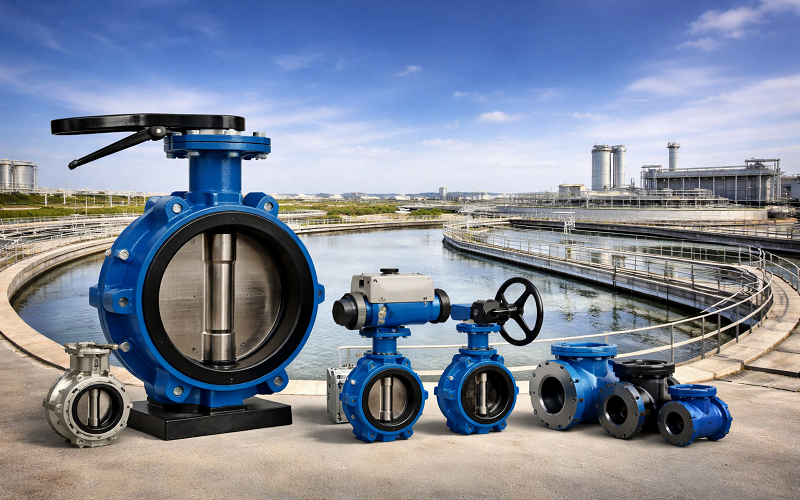
My first experience in the Indian industrial sector is something I won’t forget. The project was a huge municipal water treatment facility in Maharashtra,where selecting the right butterfly valve manufacturer in India was critical. We were in the late monsoon season, there was high humidity, and everyone was on the edge of their tempers. The pipeline system we had was supposed to be the “crown jewel” of the district. Procurement, in their infinite wisdom (and their desperate attempt to save 12% in the budget), chose a localized, unbranded supplier for the main isolation valves.
At six months, a valve failed during a regular surge test. The internal liner of the valve had delaminated, the disc was stuck half-way, and the water hammer was so severe that the secondary pump house was almost destroyed. In hindsight, this was a textbook example of being penny-wise and pound-foolish. We saved a few lakhs upfront but with the downtime we experienced and the cost of emergency repairs, we ended up paying triple.
That incident was an eye-opener for me and is one of the lessons that I still use today in B2B marketing. Simply put, when you are talking about the very core of your business, going cheap can be your biggest mistake. You are not just purchasing some metal and rubber here, you are buying operational efficiency, safety, and if you are a project manager like me, the ability to have a good night’s sleep.
If you are in the process of trying to find a butterfly valve manufacturer, you probably have a lot of questions. The Indian scenario is like a gigantic and fiercely competitive haystack. On the one hand, there are world-class companies and ‘garage operations’ next to them, which use dubious materials.
And so, we are going to eliminate the noise right away. This piece is not a brochure but a guide to help you in your selection of butterfly valve suppliers for water treatment facilities.
Why the Butterfly Valve is Essential in Water Purification
When it comes to water treatment plants (WTPs), the control of flow is paramount. You have different stages of water treatment raw water extraction, chemical dosing, filtration, and finally, high-pressure water distribution. Among the various types of valves, the butterfly valve is extensively used due to its petite structure and quick 90-degree turn operation.
Unfortunately, though, water treatment facilities tend to be tough habitats for these devices. You are talking about heavily corrosive chemicals, sediment that is abrasive, and the ever-present risk of “bio-fouling.”
The Cost of a “Slow” System
Nowadays, in the world of trade, time is money. But in the case of a WTP, the “time” is your valves reacting immediately to the changes in the system. If a valve is too slow to actuate or does not seal properly, you will have to deal with wastage of chemically treated water, an imbalance in the use of chemicals, and in the worst case a total system shutdown.
Main Takeaway: Being fast here does not mean rushing the procurement process, but it means being able to identify a partner whose product decreases delays and works efficiently.
Setting Your “Non-Negotiables”: The Technical Bar
It is very important that you determine your specifications in great detail before even starting to Google butterfly valve suppliers. It is a common misconception that “a valve is a valve,” and this is where most people run into trouble.
- The Metallurgy and Liner Quality
The quality difference between the best and the rest is a huge gap in India. If you are working in a WTP, then your main concern should be with the disc and the seat.
- The Disc: Is it Stainless Steel (CF8M) or Ductile Iron? For treated water, DI with a nylon coating may be sufficient, but if you have raw water with high salt or chemical content, don’t lower your standards, go for high-grade stainless.
- The Seat (Liner): Be Leakproof! EPDM is the standard for water, but the quality of EPDM is what really changes the game. I’ve seen low-quality liners that get brittle and crack in less than a year because they were “value” options with questionable material purity.
- Sealing and Pressure Ratings
You should know if you want a “wafer type, “a “lug type,” or a “double-flanged” valve. In the distribution of high-pressure lines, the king is generally a double-flanged eccentric butterfly valve. It acts by reducing the friction on the seat, thus lessening the wear and tear of the valve.
- Actuation and Automation
The trend is to have “smart” plants. Will you be handling the valve manually or do you require electric/pneumatic actuators that can communicate with your SCADA system? State-of-the-art butterfly valve manufacturers are expected to provide solutions that allow you to monitor system performance in real-time.
Certifications: The Paper That Guarantees Performance
In India, getting certified is more than just fulfilling some paperwork requirements; it is like a promise from a third party.
The ISI Mark and Beyond
Just as you wouldn’t buy a power cable that doesn’t have an ISI mark, you shouldn’t be purchasing a valve for a government project that lacks compliance to IS 13095 (the Indian standard for butterfly valves).
However, if you intend to compete globally, here are some of the certifications you should consider:
- ISO 9001:2015: Quality assurance processes are consistent and well implemented.
- WRAS (Water Regulations Advisory Scheme): This certification is the ultimate proof that the materials used will not contaminate the drinking water supply.
- API 609: In the case of your WTP being a high-pressure or industry-grade water type, this international standard will be mandatory.
If a manufacturer’s website has their certificates hidden in some obscure corner, then to put it bluntly, it’s a red flag. The big names are always proud of displaying their documents.
The Reality Check: How to Examine the Manufacturer’s Competence
After you have narrowed down your list of butterfly valve manufacturers based on your technical requirements, you should consider other aspects apart from the brochure. What you want is a partner rather than a supplier.
Manufacturing and R&D
If you are to make the right choice, your partner should be at the forefront of innovation and not a company stuck in the 1980s. Valve manufacturing nowadays incorporates a good deal of modern technology. To give you an idea, here are some things you can find out:
- Do they have in-house testing labs? Are they testing their valves under high pressure and checking the “zero-leakage” by themselves, or are they only sending a sample to a third party once a year?
- Do they use CNC machining? The precision required for the “interference fit” of the butterfly valve disc is quite high. Even a 0.5mm error could cause an increase in the torque and eventually the motor failure of your actuators.
Logistics and Scale
A quote from a small manufacturer might be so attractive, but what would you do if the need arises for a 500-valve order for a project spanning several cities? Look at the concrete case studies of their previous works. If they haven’t executed the “scale and speed” requirements of a major WTP project, then in essence you are financing their practice on your project.
The Price vs. Value Paradox
Yes, of course, we all have to work within a budget. The Indian market is teeming with small, unorganized players who can undercut the prices of the big brands by as much as 20% to 30%. It’s quite tempting. I know.
The Hidden Costs of “Cheap” Valves
That “cheap” offer has almost always a scary downside hidden in it. So what are the avenues that these guys use to cut their costs?
- Undersized Castings: A valve body that’s too thin might meet the pressure rating on paper but fail under a real-world water hammer.
- Recycled Scrap Metal: If they use “junk” iron or steel with high impurities, the valve will corrode from the inside out.
- Substandard Liners: This is the most common “scam.” A thin or low-grade rubber liner will tear, leading to internal leaks you won’t even see until your water bills (or energy bills) start climbing.
Actionable Advice: Do not bargain for the lowest price; rather, go for one that complies with the regulations. When soliciting offers, insist on each manufacturer providing a certificate of origin for their raw materials.
Check your local supplier’s prices relative to those of established butterfly valve manufacturers such as L&T, Advance Valves, or Intervalve Poonawalla. Suppose a quotation is significantly lower I mean, they are using the very same raw materials, aren’t they? Then, you should exercise great caution. Saving so much can only be achieved by skimping on the material itself.
Execution and ROI: The Long Run
Ordering a butterfly valve is not a task in which you “set it and forget it.” In fact, if you are setting up a contemporary water treatment plant, you need to consider the Return on Investment (ROI) over a 15- to 20-year span.
Maintenance and “Continuous Improvement”
You require a working culture and a mutual trust for the successful completion of the implementation. Will the manufacturer be giving you after-sales service? What if a valve starts “drifting” or leaking, will they be coming to your plant in Rajasthan or Kerala to fix it, or will they just let you fend for yourself? A dependable vendor will also assist your personnel in:
- Correct installation: To avoid “pinching” the liner when tightening the flange.
- Actuator calibration: Guarantee the “fully closed” position is actually fully closed.
The Hybrid Approach
At times, you may consider following a “hybrid” strategy, just like Pernod Ricard did when implementing AI. For high-pressure intake and main distribution lines, you go for top-tier, global-standard butterfly valve manufacturers, whereas for low-pressure, secondary utility lines, you rely on local mid-range specialists who are dependable. The cost is thus offset without the “critical” nodes of your plant being compromised.
Future Proofing: Solar and Smart Water
WTPs are becoming more and more integrated as India moves towards 500 GW of clean energy and “Smarter Urban Areas”. We have seen an increase in the demand for valves capable of operating in remote solar-powered pumping stations.
It would be good to know if your chosen manufacturer is researching these areas when you are in the process of selecting one:
- Low-torque designs: This would be a necessity if you are running on solar or battery power only.
- IoT Integration: Is their valve able to provide data that helps you to detect the ‘waste’ or ‘leakage’ at the very early stages?
The companies who are committed to this kind of research do not only keep up with the times, they are preparing for your needs in five years.
Conclusion
In short, here lies the bottom-line:
Characterized by great contrasts, the Indian market for industrial components is a home to some of the world’s most sophisticated butterfly valve manufacturers and at the same time, to a vast, unorganized sector where cutting corners is the norm rather than the exception.
It’s your responsibility to hold on to verifiable standards and proven records with no compromise.
- Begin with the certificates (ISI and ISO are must-have).
- Check the materials (demand MTC, Material Test Certificates).
- Investigate the procedure (inquire about the testing labs and CNC facilities).
Don’t get wooed by a slight difference in price and go against the base of your water treatment plant. The little saving you make initially is almost always paid back with higher energy bills, constant maintenance, and the worst of all possible outcomes, safety risks.
Find a partner, not just a supplier. Pick a company that is committed to their product line so that you can be sure of the future of your project. It may sound over the top, but essentially, your success hinges on the flow that you get to regulate today.
