
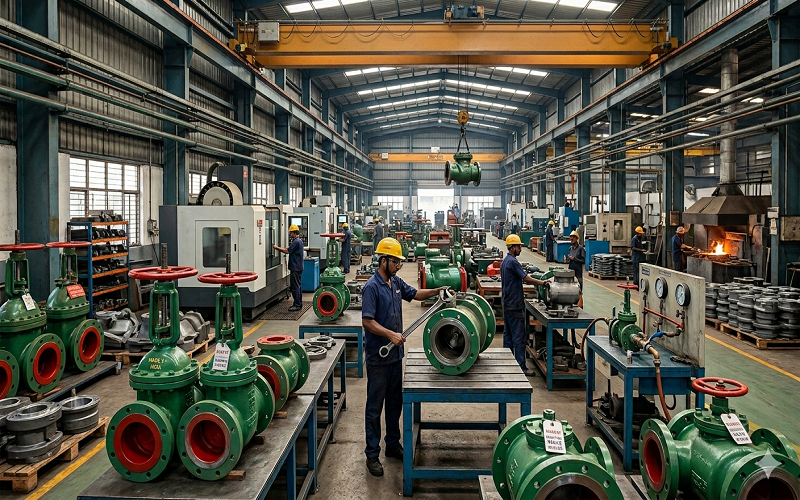
One of the most vivid memories I have is from the summer of 2019. I was on the floor of a large chemical processing plant near Bharuch, Gujarat. Clearly, the temperature outdoors was around 44°C, and indoors? Well, that was like the surface of the sun for sure. The facility manager, an experienced engineer called Rajesh, was looking at a production line that had been shut down for three days due to the failure of a “high-end” imported gate valve which had stopped functioning because of the pressure of local saline humidity and fluctuating line temperatures. He glanced at me, removed the sweat from his forehead, and remarked, “The brand was expensive, but the brand wasn’t meant for a salty breeze and a 40-degree ambient baseline.”
That was my “aha” moment. We decided to replace those valves with ones from a homegrown Industrial valve manufacturer India had evolved out of the demand for locally capable solutions sturdy, engineered for our specific climate, and with significantly shorter lead times. We often assume that “global” automatically means “better,” but in heavy industry, local expertise is what ensures equipment performs even under the toughest conditions. These manufacturers are not just suppliers; they become long-term partners. When you choose the right one, you’re not simply purchasing hardware you’re investing in engineering that understands local stresses and operational challenges. In fact, manufacturers in this space know that uptime is the only performance indicator that truly matters, ensuring your critical systems remain reliable no matter the environment.
What Actually Makes an Indian Pillow Block Bearing “Reliable”?
One can use the word “reliability” quite freely, however, for an industrial manufacturer, it has a definite technical meaning. When you buy Pillow Block Bearings from India, you get a necessity-driven product. Our natural environment is a running battle against dust, varying temperatures, and poor maintenance.
- The Metallurgy: Beyond Basic Cast Iron
Most people consider housings merely as metal pieces. But it is not so simple. Well, it is, but the quality is the most important thing. Leading Indian manufacturers normally utilize Grade FG200 or FG250 grey cast iron. They are doing it not only for the weight reason but also for vibration dampening.
- Useful Hint: Do not hesitate to inquire about the material grade of the housing. A very light one may result in cracks under impact loads. You would rather want the “thud” sound on the knock, not “ting.”
- The Insert Bearing: The Heart of the Unit
It is the insert that does the actual work though the housing is the one that holds it. Inserts made in India often come with a longer inner ring. So the question is, why? Simply because it distributes the weight to a larger area of the shaft. I feel that many times, we miss this point. A wider inner ring leads to less “shaft fretting,” which is the technical term for “the bearing damaging your precious shaft.”
The Strategic Advantage of Local Sourcing
Actually, sometimes people think that “local” is synonymous with “lower tech.” That is a huge fallacy in 2026. With the Make in India program gaining momentum, the R&D funds of major Indian bearing centers have sky-rocketed.
Global Quality, Local Grit
Today, the Pillow Block Bearings India makes are quite often ISO 9001:2015 certified. But here’s the big point: they usually also meet or surpass ABEC-1 tolerances. So, you are getting accuracy at the level of European brands, but with a housing which could stand a stone crusher in Rajasthan.
Customization is King
Just try to get a large multinational to change the seal material on a 500-unit order. Good luck, right? You will be stuck in a round of e-mails for months. Indian manufacturers, on the contrary, are very flexible.
- Helpful Tip: Customize your seals with Viton if you work in the chemical or abrasive environments. Most Indian suppliers have the capability to turn to this option very quickly compared to a global giant.
Sourcing Checklist: 5 Things You Must Ask Your Supplier
Buying the Pillow Block Bearings Indian way? Then just browsing through the catalog will not be enough. Make a call. Ask the hard questions. This is what I personally consider:
- Locking Mechanism? Set screw (standard) or eccentric locking collar? The eccentric collar is a vibration-proof locking mechanism.
- Grease Compatibility: What grease was used to pack them? Factory grease and your brand of lithium grease may have a chemical reaction.
- Housing Tolerance: Is the bore “H7”? Loosely fitted housings lead to creeping, and the entire unit heats up.
- Seal Type: Prefer a “slinger” or a triple-lip seal if you are in agriculture or mining rather than the basic rubber.
- Load Ratings: Obtain static and dynamic load ratings immediately or there is a risk supplier is a dealer, not a manufacturer.
Insider Tips: On the Indian market, numerous “dealers” are pretending to be manufacturers. Insist on a visit to the factory or at least a live video tour of the CNC shop. A genuine manufacturer of Pillow Block Bearings India won’t mind exhibiting their heat-treatment plant.
Performance in the Field: Industry Specifics
I have witnessed these bearings in every corner of the country from huge conveyor belts in Mundra Port to the small flour mills of Punjab.
Agriculture: The “Dust” Factor
In farming, contamination is the direct cause of failure for bearings. Indian-manufactured pillow blocks typically come with robust “shrouds” that are able to block large debris even before the seal is touched. It’s a straightforward, robust principle, and it gets the job done.
Food & Beverage: The “Washdown” Struggle
The problem is big here. If you belong to a dairy or a bottling plant, you will have to spray the equipment with high-pressure water and chemicals every night.
- Recommendation: Thermoplastic housings or stainless steel inserts. Of course, they are more costly but it is a fact that repeatedly buying a rusted cast iron block can become the most expensive option.
Cost vs. Value: The “True” Price of a Bearing
We are talking about money now. I mean, purchasing teams, I have witnessed, planning to save ₹200 on the bearing only to lose ₹2, 00, 000 worth of production time due to its failure later.
Your local purchase of Pillow Block Bearings in India is not just about low cost at entry. It is a whole operational cost that you should calculate. And what will happen if you diminish your lead time from 12 weeks to 12 days? Your “safety stock” can be reduced. Your capital will not be locked up in a warehouse full of spares “just in case” the ship from Germany is delayed.
Final Thoughts: Making the Switch
Hey, I am not advocating that you should completely stop your current suppliers right away. But if you haven’t checked out the quality of Pillow Block Bearings India is exporting these days, then you are simply wasting your chance.
Technology is ready. Metallurgy is excellent. And my professional judgment calls the toughness of the product as the best among the available price points.
Start with a small step. Choose a “problem” machine. You know, the one that always needs a bearing replacement during the graveyard shift. Replace it with a top-grade Indian pillow block. Do vibration monitoring. Measure temperature. You will be amazed how quiet and cool it is.
Efficiency does not always come from costly parts only. Efficiency comes from having the most suitable components for the environment. For the industrial scenario in India and worldwide, this often means looking right here at home.
FAQ: Quick Hits for the Busy Engineer
Q: If I want to, can I use a pillow block made in India instead of a Japanese one?
A: Of course, you can, if the dimensions “Bolt Hole Center-to-Center” and “Base-to-Center” are exactly the same. Most Indian manufacturers keep to international standard dimensions (UCP series).
Q: What’s the difference between Plummer Block and Pillow Block?
A: They are often used interchangeably, but strictly speaking, a Pillow Block usually means the lightweight, pre-assembled unit with a ball bearing whereas a Plummer Block is typically a larger, split housing used with spherical roller bearings for heavy loads.
Q: How do I know when I should re-grease?
A: It depends on speed and heat, but if you ask for a rule of thumb: If you can’t touch the housing because it’s hot, you’re probably over-greasing or under-greasing. Have a greasing schedule and stick to it rather than “when I remember.”