
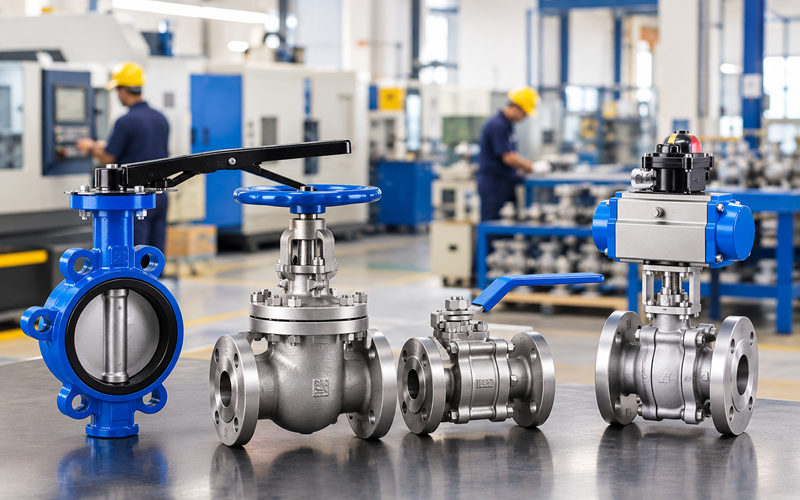
That memory of a phone call from a site manager at midnight in 2018 still lingers in my mind. We were commissioning a major chemical processing line in Gujarat when a critical batch of standard gate valves, purchased from a low-bid supplier promising “global quality at local rates,” started leaking from their seats during the very first pressure test. This experience highlighted why choosing a reliable valve manufacturer India is so important for industrial projects.
It was not a small drip that could be ignored. The continuous hissing sound of escaping pressure brought the entire project to a sudden halt. The client was losing a significant amount of money every day due to the delayed startup, while the procurement, engineering, and supplier teams struggled to identify who was responsible. That was when I truly understood an important lesson: an industrial valve is much more than a piece of metal designed to control the flow of fluids. It is a critical component that protects plant safety, ensures uninterrupted operations, and supports long-term profitability.
If you go through the industrial landscape now, selecting a partner to supply such vital components would be like navigating a trapfield. The market is flooded with choices, tech jargon getting thrown at you all the time and everyone flaunting themselves as a big industry player through nicely printed brochures. But to tell the truth, how does one distinguish real innovators from copycats?
If you are in charge of the vendor selection process for a top valve manufacturer India, simply casting the ability to cast iron or forge steel is grossly insufficient. Your strategy for the selection has to be based on the actual operational parameters.
The Strategic Foundation: Moving Beyond the Lowest Bid
We will have to admit that the lure of going for the lowest bid is quite strong. I mean, just imagine, when you are looking at the procurement spreadsheet and one of the vendors is offering to give you the same product for 20% less than others, you just cannot resist the urge to take that savings at face value. This is where heavy industries operate on a different set of rules where nearly every time, the cheap option becomes the very expensive mistake you will be making.
Understanding the Total Cost of Ownership (TCO)
Using the analogy of valves as high-tech equipment, when a compromise is made on the upfront cost, it is not really a case of saving money but only of transferring the expenses to the risky buckets of “unplanned downtime, emergency maintenance, and early replacement”. Hence a cheap valve will have small hidden corner-cutting that you will not discover until it is too late:
- Poor metallurgy: Scrap-based melts or heterogeneous alloy distributions that weaken when exposed to high temperatures or corrosive environments.
- Inferior sealing elements: Use of low-quality elastomers or packing material that dry out, become brittle, and eventually fail way before their scheduled downtime for maintenance.
- Loose dimensional tolerances: Bypassing final machining steps which result in micro-gaps causing fast erosion and wire-drawing phenomenon across the valve seat.
The loss due to valve failure extends far beyond the price of the replacement part and can include production stoppage, changing of lines, risk of environmental penalties, and work safety hazards. The real return on investment is not a simple payback on the invoice date but the quiet performance-free operation over a period of five, ten, or even twenty years.
The Power of “Speed to Market” in Supply Chains
Another dimension that people tend to neglect is the role of speed. And by speed, I definitely do not mean that the suppliers end up delivering products in an unsafe and by-pace manner just to beat the deadline. The supply chains of leading businesses are agile enough to respond to changes without any fuss and/or they are able to optimize the production schedules as well as communication lines.
You must be very clear with your manufacturing partner if you consider a three-week turnaround time just for sending you back the updated technical data sheet or getting a design change approved through the internal bureaucracy. Additionally, fast decision-making by a supplier complemented with live visibility into the inventory is that winning factor for your project in the current situation where deadlines are compressed to the maximum.
Design and Engineering Prowess: The Heart of Reliability
A great valve is the result of a great engineering team. Many buyers treat industrial valves as a mere commodity, forgetting that these tools are exposed to extreme conditions such as thermal cycling, pressure spikes and aggressive chemicals on a daily basis.
Casting vs. Forging: The Structural Choice
In fact, one of the first technical questions you will probably have to answer is: what method is employed when it comes to manufacturing the valve body? Is it a casting or forging?
Casting valves are most suitable for bigger sizes (usually beyond 2 inches) as well as complex body shapes such as globe or double-block-and-bleed valves. Here your role is to assess the capability of the foundry. An in-house foundry-experienced manufacturer or a controlled and regularly audited foundry partner can monitor various phases such as material melting, cooling and composition in order to avoid defects such as porosity, blowholes, or sand inclusions.
Forged valves on the other hand are best in situations where the applications involve high pressure and temperature that mechanical integrity must not be compromised. In addition, forging leads to a finer grain structure making the metal much stronger against thermal fatigue and cracking.
Wall Thickness and Pressure-Temperature Ratings
Good design never involves taking risks with minimum compliance limits. Thorough engineering teams take into account the corrosion allowance and design the valves with sufficient wall thickness so that the structure of the plant is not compromised even if your process fluid becomes more aggressive than originally anticipated. They work to internationally recognized standards such as ASME B16.34 which lays down clear guidelines in terms of pressure-temperature ratings, dimensions and material groups.
Rigorous Quality Control and Certification Frameworks
Now moving on to something totally mandatory: validation. Anyone can claim that their products are great but such claims are baseless without verified, independent, third-party validation. When scouting for a Valve Manufacturer India, the compliance and quality management systems of a manufacturer must be your first serious selection criteria.
Below is a table showing common certifications for valves and what it means.
Core Certification StandardWhat It Specifically GuaranteesAPI 598 / ISO 5208Hydrostatic and pneumatic seat and shell leakage rates under pressure.IBR (Indian Boiler Regulations)Absolute compliance for steam and high-pressure boiler feed systems.API 607 / API 6FAFire-safe testing; ensures the valve maintains seals during a blaze.ISO 9001:2015Consistent, repeatable quality management systems across production.
The Indian Boiler Regulations (IBR) Imperative
IBR certification is mandatory, legally, if your project involves steam generation, power infrastructure, or high-pressure thermal fluid lines within India. It signifies that not only the paperwork is in order but the authorized inspector has actually witnessed the signing off on the material heats, physical properties and components. You can definitely save yourself the regulatory challenges with commissioning if you have a partner who knows the IBR Form III-C documentation inside out.
Testing Beyond the Bare Minimum
Having an in-house testing lab certified by a national body like NABL is a major advantage. You will want to see the following:
- Positive Material Identification (PMI): Using X-ray fluorescence to check the composition of the alloy before any machining is done. No throwing dice.
- High-Pressure Hydrostatic Shell Testing: They run the valve body well beyond its rated pressure level to eliminate the possibility of any micro-fissures in the structure.
- Fugitive Emissions Testing: This ensures that harmful or volatile substances do not escape through the packing gland keeping your plant in line with environmental regulations.
Automation, Customization, and Smart Flow Systems
Simply relying on a handwheel-operated valve is quickly becoming a thing of the past. As local and global industries are speeding towards automation, even your sourcing criteria will have to change. The discussions have now moved from simply mechanical assembly to highly complicated system integration.
Actuator Integration and Compatibility
A valve is as good as the system that actuates it. Whether you are talking about pneumatic rack and pinion configurations, heavy-duty electric actuators, or quick-acting hydraulic systems, you should only consider a partner who sees actuation as a principal engineering skill and not as a secondary thing.
Make sure to check for the most recent machining standards such as ISO 5211 which refers to mounting pad interfaces. This means that if in the future you have to replace an actuator or install a digital positioner, the new parts will fit without any need for custom field welding or unsafe modifications.
Transitioning to the “Future-Perfect” Valve
What amazes me most about the industry is its future. It is all about smart systems. Integrated logic controllers and smart positioners field data capture are the talk of the day.
A valve that counts its cycles, measures torque signatures and notifies the maintenance team ahead of a failure is the strategic differentiator. It turns your operation from reactive fire-fighting into predictive maintenance resulting in very high uptime and very predictable operational costs.
Navigating the Indian Sourcing Landscape: Red Flags and Best Practices
Domestic market is huge, highly fragmented and full of extremes. You can get to see world-class manufacturing facilities comparable with those in Europe or North America, but at the same time, you will be faced with unorganized workshops that try to win the order by cutting corners to the maximum extent.
Spotting the Red Flags
Whenever you check a partner for potential, these are some of the warning signs you should be looking out for:
- Lack of or hidden documentation: For example, if the client has to keep pressing the supplier for the EN 10204 Type 3.1 material test certificates, then that is a big red flag.
- Prices are too low to be true: If someone’s pricing is incredibly much lower than the average market price of, don’t you know? You will have to be very sceptical of them from that moment. They’re also using globally traded, volatile raw materials such as copper, nickel, steel, etc. So basically, the only way to save that much money is either to compromise on material quality or skipping major testing protocols.
- Absence of backward integration: Overreliance on random third parties for basic castings and rough machining results in wild quality variations between production batches.
Actionable Sourcing Best Practices
Protect your investment and supply chain by enforcing a structured validation routine. First, verify that a test certificate accompanies every valve linking back to the heat number of the metal. Secondly, hold a factory audit or have a trusted third-party such as Bureau Veritas or TUV conduct the inspection of assembly lines and witnessing of pressure tests to production firsthand.
Lastly, you want a vendor partner who prefers an open line of communication coupled with a clearer alignment of technical aspects rather than merely ramping up the sales quickly. You should expect that your leading Valve Manufacturer India being relied upon will also study in detail your process parameters like media velocity, chemical concentration, flashing potential so that a perfect match of the valve variant with the challenge in the field is ensured.
The Long Game: Partnership and Lifecycle Support
The final step should be known that a good sourcing decision is not a onetime thing, but a gateway to a long-term operational partnership. A happening of the industrial partner can actually be tested only long after the initial shipping crates have been unloaded at the site.
Robust Packaging and Field Support
The importance of receiving a high-quality, precision-engineered valve in a condition where the flange faces are undamaged and the stem is not bent due to careless handling of packaging cannot be overstated. To start with, top-grade manufacturers heavily rely on export-quality wooden crates, and every raised face is covered with a protective plastic wrap. Apart from that, their field support teams are there to help your workers with installation, getting the right bolt-tightening sequence, handling structural supports and commissioning orientation.
Transparent Warranty Claims
Simply, a warranty is only as good as the one who backs it. Hence the need to always be on the lookout for reasonable and straightforward terms without legalese that confuses. A manufacturer who stands behind their engineering should be such that raising a claim will not turn into a battle of wits, but rather, an efficient and collaborative effort to bring your line back up and running in no time.
Final Thoughts: Make a Decision Rooted in Excellence
So, where do we stand now?
Taking a close look at options before you, the way forward gets very clear. It is not with flow control infrastructure sourcing that you want to take a gamble.
Your workers’ safety, process efficiency measures, and long-term viability of your investments are solely dependent on the integrity of these components that are responsible for holding back such pressurized forces.
Devoting attention to verifiable standards, advanced engineering practices, speed of operations, this will be the way to identifying a world-class Valve Manufacturer India can totally trust with its industrial future. Don’t let short-term savings make you blind to the great value of reliability, precision, and dedicated support. Pair up with an engineering partner who deeply invests in their products so that you can confidently build your next big industrial project.
