
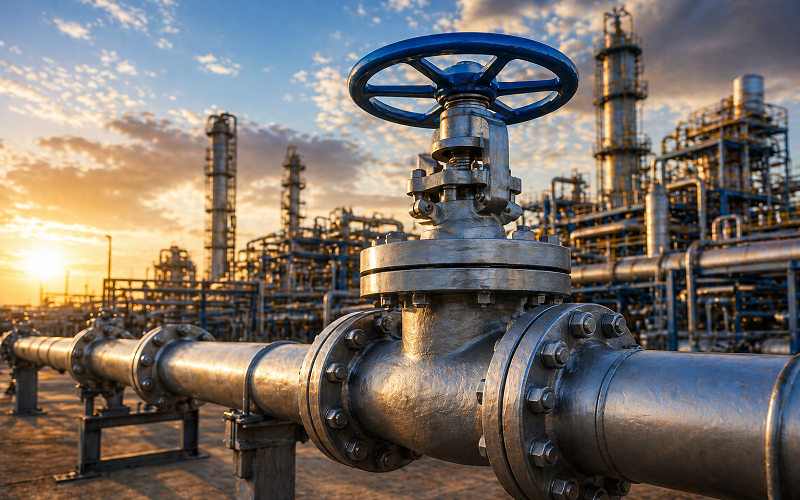
To be perfectly honest, I had been on factory floors more than I would want to remember. An industrial site has a very distinctive smell, a mixture of cutting oil, heated metal, and that trademark faint ozone scent of heavy machinery; it’s something that lingers with you. Working closely with industrial valve manufacturers India, I’ve experienced these environments firsthand. But there is one instance from the very beginning of my career that I remember very clearly, and it was not even related to the smell. It was a sound that sparked this memory.
I was in Gujarat at the site of a huge chemical processing plant. We were carrying out a high pressure test on a newly constructed section of the pipeline. Everything was going well until we reached about 80% capacity. Then a tiny, high pitch hiss appeared which was at first very indistinct but then became louder and clearer. It was like a kettle whistling and in a room full of turbines it was actually the most terrible noise that I ever heard. So, the valve which was a gate valve and leased from a so called ‘budget-friendly’ supplier to save a few lakhs was actually failing. The casting contained a microscopic porosity defect which was only revealed when under stress. We had to shut down the system, purge the lines, and a replacement arrived after a long three-week wait.
That ‘saving’ ended up costing the client nearly forty times the price of the valve through lost production.
This was when I realized the truth. Valves in infrastructure are not just pieces of equipment; they are, in fact, the physical protectors of safety and profit. When you make a purchase of Industrial Valve Manufacturer India, you are pledging not only the stainless steel or cast iron piece but also the assurance that your plant will not break down on you unexpectedly.
The Strategic Landscape: Why India, and Why Now?
The entire industrial world is being re-shaped and I am not talking about small changes. For years, the story revolved around Western engineering or East Asian mass production. And now? India has managed to create a remarkable middle ground that I find extremely interesting. India combines deep technical knowledge of European standards with a scale of production that one just cannot fathom without witnessing it.
Currently, the Indian valve market resembles a fiercely competitive, rapidly growing haystack. With the government’s initiative for green hydrogen, the expansion of the National Gas Grid, and the massive enhancement in water management, demand has surged drastically. Yet here is the icing on the cake: the difference between industrial valve manufacturer India of the highest quality and a ‘backyard’ casting shop is nothing short of a chasm.
In this situation, a well thought out plan is indispensable. You cannot simply trust a brochure and hope for the best.
Defining Your “Non-Negotiables”
Before even calling a manufacturer, you must be very specific. Many assume a valve is a valve, but this assumption is the source of a lot of problems indeed it is the fastest way to a maintenance nightmare.
- Understanding the Media: What actually flows through the pipes? Is it an abrasive slurry? High-pressure steam? Corrosive acid? While a standard WCB (Wrought Carbon Steel) valve body may suffice for oil, handling seawater will require a Duplex or Super Duplex stainless steel.
- Considering the Environment: Is the valve located in a humid, salty coastal refinery or a dry, dusty power plant in Rajasthan? Both external corrosion and internal wear can be fatal.
- The Role of the Valve: Is it a valve that remains open through six months or is it one that modulates every three minutes?
The Three Pillars of Technical Excellence
When a manufacturer is on my list, a lobby or other superficial aspects don’t influence the decision at all. “Pillars” are what I examine and if the following three are shaky, I wave goodbye.
- Metallurgy and Casting Integrity
Most of the failures in the “cheap” valves are due to this area. Metal chemistry must be accurate. I have also seen “316 Stainless” valves whose composition was a thinned mixture of scraps.
- Purity: PMIs (Positive Material Identification) are a must in the eyes of top manufacturers for each heat.
- Casting vs. Forging: For Class 900 and above pressure ratings, forging is generally the preferred method so as to avoid the porosity problem I was talking about earlier. If the manufacturer is producing castings, inquire about their Radiography (RT) or Ultrasonic Testing (UT) processes.
- Design Standards (The “Alphabet Soup”)
The lack of API, ASME, and ISO language fluency should lead you to leave a manufacturer immediately.
- API 600 / 603: Gate valves benchmark for petroleum and natural gas sectors.
- ASME B16.34: Governs pressure-temperature ratings and essentially serves as the “safety rulebook.”
- Fugitive Emissions: Considering the environmental, social, and governance focus of today, “low-leak” packing (API 622 or 624) is not something you can do without. In addition to the leakage of products, environmental contamination from methane or VOCs can also generate hefty fines.
- Precision Machining and Seating
The critical area of a valve is the seat. Metal to metal or soft-seated ball valve, the tolerance is in microns. It is a pleasure for me to note factories equipped with multi-axis CNC machining as opposed to manual lathes. Contrary to hobbyists whose manual work is good, a 24-inch high-pressure line cannot afford uncertainties at this stage.
Certifications: The Paper That Guarantees Performance
When it comes to India, certifications are undoubtedly your top and most indispensable tool. They are not mere formalities, instead, they stand as a third-party verifiable commitment that the company truly does what it claims.
Pro Tip: The need to search through hidden pages or waiting for three days for a manufacturer to mail a copy of their ISO certificate is a hallmark of a red flag. An Industrial Valve Manufacturer India, proud of his work, will not have to hide his/her credentials.
The Essential Checklist:
- ISO 9001:2015: The most basic certification that implies that the company has a quality control process.
- API Monogram: Stating ability to affix the API monogram on valves means that the manufacturer undergoes regular audits by the American Petroleum Institute. There is probably no higher trust mark in the oil and gas sector.
- CE/PED: Shipping to Europe or working with internationally-minded stakeholders necessitates the presence of this certification.
- SIL (Safety Integrity Level): SIS-related valves such as emergency shutdown ones have to be SIL certified.
The Reality Check: Going Beyond the Brochure
I have come across so many brochures and every one of them claims that their manufacturer is ‘the best.’ But when you as a customer have to make a source decision for a very large, multi-crore project, you want to see ‘Evidence of Modernity.’
In-House Testing Labs (The “Torture Chamber”)
Has the manufacturer got a NABL-accredited laboratory? Are they blasting their valves using high pressure, examining for fire-safety (API 607), testing for cryogenic performance? If a manufacturer is carrying out testing of products within their premises, it is a manufacturer who wants to uphold his/her reputation. If the manufacturer’s attitude is that of a ‘sample chuck’ once a year, then they are a mere supplier, not a partner.
R&D and Future-Proofing
The world is moving toward “Smart Valves.” I’m talking about valves equipped with sensors that can predict failure before it happens. Is the Industrial Valve Manufacturer India you’re looking at investing in IoT integration? Are they looking at hydrogen-ready materials?
The energy transition is happening fast. Solar-thermal plants need specialized molten-salt valves; green hydrogen needs valves that can handle the tiniest molecules in the universe without leaking. Companies pouring time into research today are the ones who will be around to support you ten years from now.
The Price vs. Value Paradox: Why “Cheap” is Expensive
Look, I get it. Procurement teams are under immense pressure to cut costs. And in the Indian market, you will always find someone who can do it 20% cheaper. But I want to be very clear here: There is no magic in valve manufacturing.
The price of raw materials, nickel, chrome, molybdenum, is a global commodity. If a quote is significantly lower than the market average, the savings are coming from one of three places:
- Substandard Material: Using “dirty” scrap or thinner wall thicknesses than the standard requires.
- Skipped Testing: Skipping the labor-intensive NDT (Non-Destructive Testing) or hydro-testing.
- Poor Human Capital: Using unskilled labor or outdated machinery that leads to inconsistent quality.
Buying a cheap valve equals borrowing money with a high interest rate that you will repay later in the form of higher energy bills, maintenance problems and possible safety hazards. For one thing consider the losses in electrical systems, valves have their equivalent in the “Pressure Drop”. A bad valve design causes turbulence and friction and consequently pumps have to work harder. The cost of this additional electricity over five years can be more than the initial valve price.
The Emerging Opportunities in the Indian Market
Despite the challenges, the current growth in India offers some pretty exciting opportunities for savvy buyers. The government’s focus on “Make in India” has led to a surge in sophisticated local players.
- Water and Wastewater: With the Jal Jeevan Mission and urban upgrades, there’s a massive need for reliable sluice and butterfly valves.
- Renewables: As we aim for 500 GW of clean energy, the need for specialized valves in solar and wind support systems is jumping fast.
- The 5G Impact: Even data centers need cooling systems, and those cooling systems run on… you guessed it, pipes and valves.
What I mean to say is, the market is maturing. Manufacturers with backward integration, i.e. those having their own foundries, are on the rise. It not only allows them to manage raw material risk better but also helps them to keep their prices stable even if the global market is volatile.
Building a Partnership: The Long Game
A valve purchase isn’t a one-time transaction. It’s a 20-year relationship. Or at least, it should be.
The Value of After-Sales Support
What happens when a seal wears out in three years? Does the manufacturer have a service team that can be on-site in 24 hours? Do they keep spare parts in stock, or do you have to wait for a “production run”?
After-sale service also includes the ability of the valve manufacturer to provide onsite support for the installation such as proper flange alignment, torque requirements, and actuator calibration which is particularly valuable when the set-up involves custom or heavy duty cabling or piping.
Transparency and Documentation
Leaders and inspectors will definitely express their gratitude if at a later point you maintain your records well. How easy or difficult is it to obtain MTCs (Material Test Certificates)? Is it possible to trace the ‘pedigree’ of a valve to the exact heat of steel it was poured from?
This might seem trivial for now, but trust me the time and effort in locating a single missing approval sheet during a final safety audit can wreak havoc with the schedule of a project.
Conclusion
Anyway, here is the bottom line, my final actionable advice:
The Indian industrial valve market could be considered as a collection of extremes. On the one hand, there are facilities which are world-class and can easily compete with those located in Germany or Japan and on the other hand, there are also shops that are, well, not that. It is your role that you should never stop at the point of just meeting minimum criteria but rather stick to the highest standards.
- Start with the Standards: API and ISO are non-negotiable.
- Verify the Metallurgy: Ask for the MTCs and consider independent PMI.
- Check the Factory: If possible, do a virtual or physical walkthrough. Look for CNC machines and organized testing stations.
- Value over Price: If a deal looks too good to be true, it’s probably because the valve is “thinner” than your safety margin.
I realize that it perhaps sounds exaggerated, but the safety and the success of your business are closely linked to the valves that you select today. Well, you are essentially creating the foundation of India’s infrastructure. So please do not let a 10% price difference be the reason why your project ends up making that scary ‘teakettle’ sound three years from now.
Select a partner not only a supplier. Industrial Valve Manufacturer India that is well established is one who constantly improves their products and hence you can confidently plan for your project’s future. So, power on your pipelines with assurance.
